


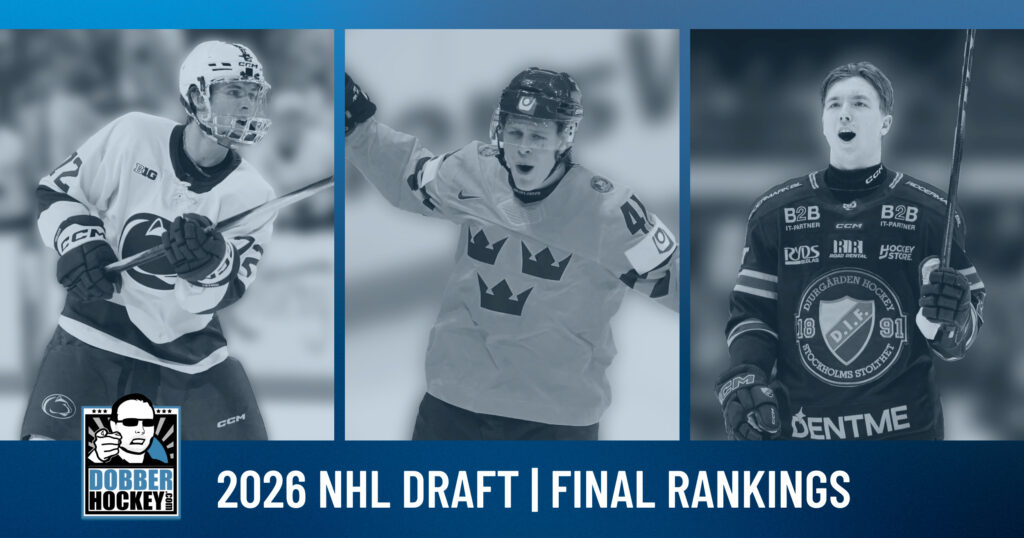
We’ve finally reached the end of draft season, which means the Dobber Prospects Draft Team’s Final Ranking has arrived.
The team presents an article featuring 105 draft eligible players for the 2026 NHL Draft. Compared to our mid-year ranking, there have been modest changes within the top-10 of the draft, and more stark changes through the middle of the first round onward.
After two incredible years in terms of both high-end talent and depth in 2023 and 2024, the 2025 draft was viewed as a noticeable drop in aggregate talent. The 2026 draft is a fine draft, but it likely slots just above the 2025 draft in terms of overall talent. The team likes the depth of this draft more than 2025, while the top 10 is similar.
The two biggest risers since the mid-season rankings are C Viggo Björck (from 9th to 3rd) and winger Wyatt Cullen (outside our top-32 to 11th). The team is admittedly one of the highest outlets on Björck, but we see elite level skill, playmaking, and compete, which should more than offset his lack of size.
The biggest faller in our ranking is Ryan Roobroeck (15th to 69th). The team sees the size and skill combination, but was consistently underwhelmed by the effort, urgency, and consistently displayed this past season. We hope he’s able to fix these warts to his game over the next few years.
Finally, we talk about the race for #1 overall on our ranking. The team was split slightly, but the majority of votes went to Gavin McKenna. The upside and elite level skill that McKenna brings to the table pushed him just above Ivar Stenberg.
As always, make sure to follow the team that made this all happen:
Jordan Harris—Director of North American Scouting (@jordan_NHLDraft)
Anni Karvinen—Director of European Scouting (@ScoutWithAnni)
Austin Kelly—Crossover Scout (@AustinReporting)
Ethan Lindley—Swedish Regional Scout (@gtcj10)
Ryan Ma—USA Regional Scout (@RyanMaScouting)
Zak Egan—Russia Regional Scout (@HockeyWithZak)
James Connelly—QMJHL Regional Scout (@JamesConnelly37)
Gordon Munro—OHL Regional Scout (@GordonMunro)
Jean-Francois Rioux—Goalie Scout
***
1. Gavin McKenna, C (6-0, 185 lbs)– Penn State (NCAA)
Jordan Harris – Everyone in the hockey world has known who Gavin McKenna is for years. Dating back at least two years ago, he was expected to be the surefire first overall pick in the 2026 draft. Fast forward to today and McKenna will likely go first overall, but it’s actually a debate. McKenna has outstanding skill that is best in the draft class. He creates scoring chances, mostly as a playmaker, but also as a shooter, on most shifts. McKenna has incredible vision and hands to match. There are real parallels to Patrick Kane and Artemi Panarin. But why is there some debate on whether he should be the first player picked on draft day?
McKenna has warts to his game that scouts and executives don’t often see in players who are expected to go first overall. He’s a smaller, thinner player whose skating is good, but not to the level of some past first overall picks – Schaefer, Celebrini, Bedard, etc. Given how talented and skilled he is, he should easily be able to overcome the lack of high-end physical gifts. The real issue is his play away from the puck. McKenna’s compete level is not considered a strength, and it could be argued it’s barely average. There are too many moments where he does a drive-by past opposing puck carriers. It just doesn’t seem like the same amount of urgency goes into the defensive side that goes into his offensive side of his game.
At his best, McKenna could be a top-line winger who produces 100+ points for a handful of seasons. This would require him to improve his effort level and play away from the puck, which is doable. If McKenna can’t do this, he could end up as an offensively tilted top-six forward who allows a lot of scoring chances against. Our team is betting that he will put it all together and become one of the top wingers in the NHL in his prime.
2. Ivar Stenberg, F (6-0, 181 lbs) – Frölunda (SHL)
Ethan Lindley – Ivar Stenberg is probably the most talented jack-of-all-trades type player in the 2026 draft. He does everything at a high level but rarely chases his mistakes. He blends every direction into his game by pushing the play forward, understanding when to weave side to side and spread out the opposing defenders with subtle deceptive movements. Stenberg’s patience with the puck opens up lanes that he quickly bursts through with his speed, and he demonstrates the strength to maintain stability amidst collapsing defensive structures. He’s much shiftier than he is fast, but that doesn’t stop him from winning puck races.
Stenberg shows immense potential in his ability to adapt to situations in real time, reading pressure, finding gaps and making plays to exploit them. He demonstrates strong attention to detail by keeping an active stick and constantly pre-scanning. The habits instilled in his game show a level of maturity. He stops on pucks, creates contact willingly in order to establish body position on his opponents, and consistently drives the net and parks himself there. Ivar Stenberg presents one of the strongest toolkits in the draft and if he continues to polish those tools, he’ll be an elite top line winger who impacts both sides of the puck.
3. Viggo Björck, F (5-10, 172 lbs) – Djurgårdens (J20/SHL)
Anni Karvinen – We are huge believers in Viggo Björck. The highly competitive 5-9 centre has continued to prove his doubters wrong by forcing his way into a top line centre role, first in the SHL playoffs and then at the Men’s Worlds. There are still doubts amongst scouts about whether he can stick to the centre position at the NHL level, but we believe firmly in his toolkit. He’s a quick skater with strong balance and a low centre of gravity. He has above average puck skills and a deceptively good shot that he can fire quickly. Above all, he has an incredible hockey sense that he utilizes in all areas of the game. By using subtle and deceptive movements, he can make opposing defenders look foolish: he’ll force you to make a mistake and then immediately punish you with a quick pass or a shot. Undersized players must have special characteristics to make up for their lack of size, and Björck has plenty of them.
4. Chase Reid, D (6-2, 185 lbs) – Sault Ste. Marie (OHL)
Gordon Munro – The near consensus top ranked defender in this year’s class, Chase Reid is an energetic offensive right-shot defender, possessing good size at 6-2.5 and 190lbs. He is a plus skater who can change directions and throw some deceptive maneuvers to help him win positioning and walk the offensive blueline, keeping possession and helping to push play. He plays the game with great pace and is able to read and react to situations quickly and effectively, making passes to his teammates and using his strong shot to put pucks on net. Some people have genuine concerns with his defensive game but that is not something that concerns me. He uses his skating and stick to disrupt play and his large size to battle for positioning. Not to mention, with the effort he has put into improving his overall game, it feels likely that he will do this in his own end as well.
5. Keaton Verhoeff, D (6-4, 212 lbs) – North Dakota (NCAA)
Austin Kelly – Having been projected to be a surefire top-five pick, Keaton Verhoeff started sliding a bit off of draft boards after a less than stellar end to his NCAA season, which has put his top-five status in jeopardy. Despite this, he remains one of the draft’s highest upside players. Verhoeff has one of the strongest mixes of upside/floor in this draft, the 6-4 right-shot defenseman clearly mature enough to handle the physical demands of college hockey, all while being a leader on offense in the North Dakota blueline. The question mark for Verhoeff is a struggle to take his NHL-ready frame and pro traits to a higher level, making some wonder if Verhoeff is a finished product. Still, Verhoeff at his best has been one of the draft’s most dynamic and pro-ready players, likely to be a top-four defenseman, with his potential of a #1 defenseman still capable of being reached.
6. Tynan Lawrence, C (6-0, 168 lbs) – Muskegon (USHL)
Ryan Ma – Tynan Lawrence entered the season as a consensus top-five prospect, but an injury and a midseason transition to Boston University on a struggling team appeared to contribute to a decline in his draft stock. While the offensive production was not always there, his impact away from the scoresheet remained evident throughout the year.
Lawrence’s game is built around his skating, pace, and work ethic. He covers ice efficiently, applies consistent pressure on the forecheck, and contributes in all three zones. Defensively, he is highly effective, using strong stick detail, anticipation, and effort to disrupt plays, recover possession, and support transitions. His puck retrievals and ability to extend offensive-zone possessions are among his most notable strengths.
With the puck, Lawrence protects possession well, attacks open space, and regularly works his way into dangerous areas. While there are questions about his ultimate offensive ceiling, his combination of skating, defensive value, puck-winning ability, and competitive habits gives him one of the more complete and projectable profiles in the 2026 draft class.
7. Caleb Malhotra, C (6-2, 183 lbs) – Brantford (OHL)
Gordon Munro – Caleb Malhotra is a late riser in this year’s class, finding himself as one of if not the top ranked centre. His meteoric rise can be attributed to many different factors from his strong two-way abilities, positional importance, to his high end scoring numbers, especially down the stretch and in the playoffs. Defensively, Malhotra plays a sound and structured game with good positioning and reads, blocking passing and shooting lanes with his stick and body. Offensively, Malhotra flashes tons of creativity and is able to make high level passes with a variety of moves in his arsenal. He also uses his mature size and agile skating with quick cuts and directional changes to carry the puck up ice, protecting and pushing through pressure. Some try to discount his game as a product of playing on a strong team but there are many translatable and impactful traits that Malhotra has.
8. Carson Carels, D (6-2, 194 lbs) – Prince George (WHL)
Jordan Harris – Carels is a prospect without many serious flaws in his game. He has good size with a thick build which he blends with great skating and high-end physicality. This package of physical tools allows him to thrive in both zones as a junior player logging well over 25 minutes per night. Carels is a talented defender who consistently shuts down plays in his own end and prevents his opponents from entering the offensive zone with control. Carels has some of the best compete level in the draft and will deliver punishing hits along the boards and in open ice. The offensive side of his game is impressive as well, even if it isn’t high-end like some of the other defenders in the draft. Still, he can run a PP at the junior level, get pucks on net, and distribute the puck effectively. Carels picks his spots well and jumps up in the play when the opportunity arises. At his best, Carels could be a very impactful #2 or 3 NHL defenseman on his team.
9. Alberts Šmits, D (6-4, 205 lbs) – Mikkelin Jukurit (Liiga)
James Connelly – Smits might have the highest floors among all the defensemen in the class. Depending on which team drafts him, he could play in the NHL in his D+1 season. His play at the Olympics for Latvia demonstrated this, and he was arguably their best player against a gold-medal-winning Team USA. Smits’ game is built around his size, skating, and snarl. The physicality with which he approaches the game should translate well to playoff settings and will be valuable in banger fantasy leagues. Smits’ skating is best on display when he activates off the rush to create scoring opportunities. His passing is a plus trait, but he lacks a level of creativity that could limit him to the second power-play unit at the NHL level. Smits has a heavy shot as well, which he is not afraid to release from distance. The biggest question with Smits is how much more room does he have to grow? He may never become a top pair player, but he should at least be able to hold his own on a second pair based on physical traits alone.
10. Malte Gustafsson, D (6-4, 201 lbs) – HV71 (J20)
Ethan Lindley – Malte Gustafsson is a smooth skating defenseman who combines a long stride with very strong edge work in order to cover a massive amount of ice rather effortlessly. He shows evolution every game in the way that he uses his length and frame to eliminate chances against. When the opportunity presents itself he will deliver a crushing body check, but he understands when to utilize his reach and cut off plays using his stick positioning as well. His sense expands beyond his defensive game, as he’s also shown the ability to rush the puck with a fluid and evasive stride while making quick decisions in motion and at a high pace. He times his activations well and has the poise to hold onto pucks under pressure, which allows his hands and vision to make creative plays in the offensive zone. Gustafsson already has the tools to be a do-it-all defender at the next level with top pairing upside, he just needs to polish his touches and refine his gap control.
11. Daxon Rudolph, D (6-1, 194 lbs) – Prince Albert (WHL)
Jordan Harris – Rudolph is a smooth moving right-handed defenseman with size and offensive ability that’s always going to get the attention of scouts. He has a good shot and walks the line well to get into better shooting lanes to unleash his shot on net. Rudolph activates at appropriate times and can be a real threat joining the rush both as a passer and as a finisher. His draft year production in the WHL was high-end this year, and it seemed like he was on the ice every other shift logging huge minutes. The concerns with Rudolph are that while he defends well at the junior level, he defends mostly with his athleticism and skating vs. physicality and aggression. If he wants to be as good of a stopper as he is in the WHL at the NHL level, he’ll need to be more assertive on the back-end and develop a much more physical game. The addition of a higher compete level and physical game to his big frame and excellent movement, would go a long way in earning him top-4 minutes at the NHL level. While he’s put up a ton of points at the junior level, I don’t see the same level of dynamic skill that some of the other players in this draft.
12. Wyatt Cullen, F (6-1, 181 lbs) – NTDP (USHL)
Ryan Ma – Wyatt Cullen remains one of the more intriguing offensive players in the 2026 draft class. A highly intelligent playmaker, he excels at controlling pace through the neutral and offensive zones, using patience and deception to create passing lanes and generate scoring opportunities. His vision consistently stands out, whether he’s operating from the half wall on the power play or attacking off the rush.
In transition, Cullen is comfortable holding onto pucks, evading pressure with cutbacks and changes of pace before finding teammates in advantageous positions. Once established in the offensive zone, he frequently attacks from the middle of the ice, leveraging both his passing ability and a dangerous shot that forces defenders to respect multiple threats.
There are areas for improvement, particularly regarding defensive consistency and engagement away from the puck. At times, he can be overly focused on creating turnovers for transition opportunities rather than maintaining defensive structure. Nevertheless, his combination of playmaking intelligence, puck skill, and offensive creativity gives him one of the highest offensive ceilings in the class.
13. Elton Hermansson, W (6-1, 181 lbs) – Örebro (J20)
Austin Kelly – Elton Hermansson spent nearly the entire season in the second tier Allsvenskan, putting up an impressive 11 goals and 21 points in 38 games, already being one of MoDo’s leading point getters while playing a physically imposing game. Against his own age group, Hermansson has been solid but not as dominant as you would anticipate for a player already excelling among men. He has all the tools but isn’t always the best at putting his entire toolkit to good use, sometimes needing to take that extra second and plan out what to do next. There’s clear offensive upside and maturity for Hermansson to carve out a top-six NHL role, but he projects closer to a secondary scoring second-line winger. Hermansson should still be a top-20, or even late lottery pick, just based on the potential that comes with him putting everything together.
14. Oscar Hemming, F (6-4, 196 lbs)
Ryan Ma – Oscar Hemming projects as one of the more translatable forwards in the 2026 draft class. Despite losing significant development time this season due to eligibility complications, he stepped into Boston College’s lineup and quickly established himself as a reliable contributor.
Hemming’s game is built around skating, physicality, defensive reliability, and relentless effort. An explosive skater, he closes space quickly on the forecheck, wins races to loose pucks, and consistently supports play in all three zones. His physical game stands out as well, as he regularly engages along the boards, finishes checks, protects pucks effectively, and extends possessions through strong puck-winning habits.
Offensively, Hemming functions more as a connector than a primary creator. He processes the game well, moves pucks efficiently, and complements skilled teammates through intelligent support play. While he lacks the dynamic puck skill and self-creation ability of some peers, flashes of individual skill suggest there may be additional offensive upside. His combination of pace, competitiveness, defensive value, and hockey sense gives him one of the safer projections among forwards in this class.
15. Adam Novotny, F (6-1, 205 lbs) – Peterborough (OHL)
Gordon Munro – As a power forward winger, Adam Novotny boasts a sturdy frame, allowing him to blow through contact and carry pucks up ice with confidence. He also finishes his checks and is able to battle for position in all three zones with a strong forecheck and backcheck. He crashes the net hard but has the skill to make plays with the puck, scanning and finding open seams to thread passes through to teammates. On top of his playmaking, Novotny can snipe the puck, picking corners and beating goaltenders clean through his powerful release. On the defensive side, he uses his body to pressure and neutralize opponents, using his stick to steal pucks. Novotny is a great blend of translatable size, power, and energy with the soft skills to make plays, giving him top-six potential.
16. Oliver Suvanto, C (6-3, 209 lbs) – Tappara (Liiga)
Anni Karvinen – One of the youngest prospects in the draft, the September-born Oliver Suvanto is one of the safer options for an NHL GM. The sturdy Finnish center is a reliable two-way presence, the type every good playoff team has. Equipped with strong sense and an imposing physical profile, Suvanto plays a game that should translate seamlessly to North American ice. While he lacks the dynamic skill some of the top names possess, he plays to his strengths and is one of the best puck protectors of the class. He won’t become a playdriver, but it’s easy to envision him scoring a fair share of greasy goals near the net, where he’s almost immovable. Suvanto brings value in the defensive zone too, reading plays well, which allows him to position himself and strip the puck effectively. Even if the upside is limited, Suvanto is a high floor pick and a great building block for some team for years to come.
17. Xavier Villeneuve, D (5-11, 157 lbs) – Blaineville-Broisband (QMJHL)
James Connelly – Villeneuve has the highest offensive ceiling among all defensemen in this class. An undersized but supremely skilled and shifty player, Villeneuve made waves in his D-2 as the QMJHL’s defensive rookie of the year and followed it up the next year, winning the QMJHL’s defenseman of the year award. However, this year has been a bit of a letdown for Villeneuve. Heading to Boston University next year, Villeneuve has the opportunity to follow in the Hutson brothers’ footsteps as the next great undersized offensive defenseman out of BU. Villeneuve has been compared to Lane Hutson, and it is not just because he is an offensive defenseman under 6 feet. The level of poise, puck control, playmaking, and ability to evade impossible situations is eerily similar to Hutson’s. Unlike Hutson, Villeneuve needs to improve his defensive engagement and baseline defensive skill level, but his ceiling is so high that if he were to hit it, the defensive game can be overlooked as he brings that much offensively. It is worth noting that Villeneuve struggled with reported hip injuries that visibly limited his dynamism. This issue could plague his developmental years and prevent him from reaching his ceiling.
18. Ryan Lin, D (5-11, 176 lbs) – Vancouver (WHL)
Jordan Harris – Lin is a very intelligent two-way WHL defenseman. As a defender, he reads plays really well and can break up passes and deny zone entries with good positioning and an effective stick. He’s a slick mover and can walk the line from up top on the PP. Lin will activate in the offensive zone and is a real threat to score. He sees teammates effectively and is a talented passer who can hit his teammates with an accurate pass. The biggest downside with Lin is that he doesn’t have the most desirable physical traits. He’s not a very big defenseman, with good but not great skating, and he’s not a very physical player either. There are concerns that his defense might not translate to the NHL level as he could be overwhelmed with size and speed. Overall, Lin does come with some translatability risks, but he’s a very smart and talented defenseman who could be a bottom pairing player at even strength, but play on one of the two PP units.
19. Mathis Preston, F (5-11, 176 lbs) – Spokane (WHL)
Jordan Harris – Preston was another player who many outlets had ranked in the top 10-15 at the start of the season. Unfortunately, consistency was an issue for Preston over the course of the year and he didn’t look effective as often as you’d expect for a player with the skill, speed, and hands that he possesses. Part of that was due to an injury and a mid-season trade, but scouts still wanted to see more from Preston this year. When he’s on, he’s a highly dynamic winger who can burn defenders on the outside and then make a move on the goalie to seal the deal. He has a bit of a junior hockey style to his game, which will have to get eased out as he transitions up levels, but he’s worth a pick in the latter part of the 1st round because the upside is so huge for him.
20. Ethan Belchetz, F (6-5, 227 lbs) – Windsor (OHL)
Gordon Munro – The former first overall pick at the 2024 OHL priority selection, Ethan Belchetz is a bit of a polarizing player. He varies on some boards, being as high as a top 10 pick, possessing many coveted traits. He is a bit of a unicorn at 6’5 and 225lbs, he can be such an overpowering player to opponents. Belchetz has the aggression and engagement to fit into plenty of different roles at the pro level with a solid motor and decent skating, especially for a player of his size. In addition to his fundamentals, he has flashes of high end creativity and vision with the puck on his stick. He oozes a lot of potential upside for an NHL club with the ability as a dual-threat scorer and may take a long runway to put it all together but the ceiling is there.
21. Alexander Command, C (6-1, 183 lbs) – Örebro (J20)
Ethan Lindley – Alexander Command already understands how to leverage his frame and use his strength to exploit his opponents physically. He plays in straight lines, often chipping the puck behind defenses and letting his power game take control, forcing turnovers with heavy collisions and then quickly moving the puck to scoring areas. He’ll shrug off a couple of defenders like it’s nothing and then drive through the space he’s created or use it to make a strong pass to a teammate. He blends soft hands and clever anticipation with his strength to make him almost impossible to cover around the net. Command’s foot speed could be improved, but he’s shifty enough, makes quick decisions under pressure, moves pucks with pace, and understands his reads so well that he doesn’t need to be very fast. His high skill level, attention to detail, and intense mentality should make him a very reliable middle-six centre at the next level.
22. llia Morozov, F (6-3, 205 lbs) – Miami (OH) (NCAA)
Jordan Harris – There is so much to like about Ilia Morozov. He’s huge, moves reasonably well, has an excellent compete level, and plays a reliable two-way game. That alone is enough to have a good chance of becoming a bottom 6 F in the NHL. Morozov accelerated his development by going to college one year early, becoming the youngest player in the NCAA (at the time). Morozov joined a weak program in Miami-Ohio which allowed him to play significant minutes at C, but also didn’t provide him with much talent for him to play with. While 20 points in 36 games as a 17-year-old is very impressive, he didn’t display the higher end offensive traits you’d expect of a potential top-six C on an NHL team. Still, Morozov has plenty of time left in his development to develop into a more dynamic scorer, but for now he seems like a safe bet to play as a 3 or 4C in the NHL and play that role highly effectively. If he can develop more of an offensive game then middle-six C is definitely in the picture.
23. Thomas Bleyl, D (6-0, 170 lbs) – Moncton (QMJHL)
James Connelly – Aside from Caleb Malhotra, Tommy Bleyl is the 2026 class’s biggest riser. He went from playing U18 AAA in his D-1 to the QMJHL’s rookie and defenseman of the year this year. The first thing you will notice when watching Bleyl is his skating, as he is one of, if not the fastest, skaters in the class. At the QMJHL level, he can go end-to-end with relative ease, and with his speed, it is easy to envision him doing the same thing in the NHL. His ability to consistently deliver clean, crisp passes helped him on his way to leading the QMJHL in assists. In the offensive zone, where Bleyl cannot rely on his straight-line speed as much, he tends to make smart plays with the puck, but has a bad habit of flinging pucks on net under pressure at the point. Defensively, there is a lot of room for Bleyl to grow, but he always puts in 100% effort when defending, even if he loses battles. His transition defense is excellent as he can close gaps with his speed, and his stick checks are the strongest aspect of his defense. While he is a bit undersized, Bleyl is a late bloomer who is still growing and could top out over 6 feet tall. He will return to the QMJHL next year before heading to Michigan State after a presumed one-and-done year from Chase Reid. In a class loaded with defensive talent, Bleyl has the potential to be among the best.
24. Juho Piiparinen, D (6-3, 203 lbs) – Tappara (U20 SM-Sarja)
Anni Karvinen – It’s quite easy to say that Juho Piiparinen is the best Finnish prospect defenseman since Miro Heiskanen. While he’s not in the Heiskanen tier, he has the tools to develop into a solid two-way minute muncher who helps his team by stabilizing the back end. The right shot defender excels at shutting down the opponent by killing plays effectively. He uses his long reach to angle pucks or block shots and delivers crushing hits with regularity. His upside is limited due to his lack of higher end offensive tools, though he’s shown some intriguing flashes that could suggest potential for more. He has a heavy shot, though it’s not accurate enough yet, and good enough four-way mobility to create some offense from the blue line. If he’s able to blend some more offensive finesse into his game and develop his top end speed, we could be looking at a future two-way beast at the NHL level.
25. Nikita Klepov, F (6-0, 181 lbs) – Saginaw (OHL)
Jordan Harris – After losing elite level players like Michael Misa and Zayne Parekh to the NHL, Saginaw was a lot less potent than in past seasons. Fortunately, the team was still able to make the playoffs almost entirely due to Klepov and 2027 draft eligible Dima Zhilkin. Klepov is a highly talented and dynamic winger with great hands and puck skills. He has a great wrist shot and can release it in almost no time at all. While he’s not the biggest or fastest player, his size and skating is good enough, especially when you factor in the high-end offensive game he brings. While there’s some risk in Klepov’s projection, he’s one of the few players at this part of the ranking who has higher-end scoring potential. If all goes well, Klepov could be a fixture on PP1 and carve out a role as a top-six scorer.
26. Jack Hextall, C (6-0, 185 lbs) – Youngstown (USHL)
Ryan Ma – Jack Hextall continued his strong development trajectory this season with Youngstown, building on an already impressive D-1 campaign. While his skating profile is solid rather than dynamic, he consistently keeps pace with play and maximizes his mobility through strong anticipation and relentless effort.
Hextall’s greatest strengths stem from his motor, forechecking pressure, and defensive engagement. He regularly disrupts breakouts, wins puck battles, and uses his long reach effectively to force turnovers and limit offensive opportunities against. His physicality stands out as well, as he consistently competes along the boards, protects pucks through contact, and establishes positioning around the net front.
Offensively, Hextall has shown encouraging growth. He has become more assertive attacking the middle of the ice while continuing to display flashes of skill, creativity, and puck control. There are still questions surrounding his playmaking consistency and decision-making, particularly when attempting high-risk passes. However, the combination of competitiveness, physicality, forechecking impact, and emerging offensive tools gives him a compelling middle-six projection with potential for further growth.
27. Liam Ruck, W (6-0, 176 lbs) – Medicine Hat (WHL)
Jordan Harris – Name a more exciting duo than Medicine Hat’s twin phenoms, Liam and Markus Ruck. Liam torched the WHL with 45 goals and 59 assists in 68 games. Ruck does so many things well. He’s a natural scorer and should be able to score at the NHL level. He competes well and has a great set of hands. The only negatives for Liam are that he has below average size and his skating is just okay. While the upside could be top-six scoring winger, the physical limitations are very real. It seems like there are a few players every draft in the mold of Liam and Markus, and not all of them end up making it. Fortunately, those who do seem to really hit big. If all goes well, Ruck could be a dynamic scoring winger for years to come, but there is risk here.
28. JP Hurlbert, F (6-0, 183 lbs) — Kamploops (WHL)
Jordan Harris – Hurlbert was a huge signing for Kamloops this offseason after he defected from the USNTDP, and he did not disappoint. From day one, Hurlbert was the driving force behind the Blazers’ offense, nearly reaching the 100-point mark. He’s got an excellent shot, as evidenced by his 42 goals in 68 games. Hurlbert is also a dynamic playmaker as well. On the PP, Hurlbert takes his game to another level. He’s a threat to score and set-up teammates from the half-wall or drive towards the slot and rip one. The downside with Hurlbert is that he plays a bit of a junior hockey style of game, and you wonder how much he can get away with as he ascends up levels. Hurlbert also isn’t a defensive stalwart, so he’ll need to work on that part of his game as well. Hurlbert will need time to round out his game, but he should be able to be a PP1 option and 2nd line scoring winger at the NHL level if his game translates well.
29. Gleb Pugachyov, RW (6-3, 198 lbs) – Nizhny Novgorod (MHL)
Zak Egan – Gleb Pugachyov is a high end, straight line skating power forward who finishes every check. He plays a punishing style of hockey that could attract some NHL GMs. Pugachyov excels along the boards and is a pest around the net. While the counting stats might not grab attention, his style of play translated up each level of Russian hockey, from the MHL and VHL to 13 KHL games where he scored a couple of goals. Gleb’s finishing around the net is promising, but he will have to continue to work on his shot if he wants to beat a goalie from distance. His puck skills need development; Pugachyov makes the simple play effectively but struggles with high end passes. There are flashes of one-on-one moves and plays in tight that are promising. Gleb has an intensity to his game that comes out in his skating and physicality that will translate to the NHL.
30. Casey Mutryn, RW (6-3, 203 lbs) – NTDP (USHL)
Austin Kelly – The NTDP had one of their least productive scoring seasons, which hindered Casey Mutryn being able to put up a more appealing statline than he deserved. Mutryn isn’t the most dynamic forward, but plays a serviceable game with the puck in creating offense off the rush. It’s Mutryn’s defensive game, however, that is the more projectable side of his game. Along with his ability to strip pucks and break up plays to move the offensive back in his team’s favor, Mutryn is also a physical shutdown player who isn’t afraid to play hard, having not looked out of place in matches against collegiate teams. The upside of Mutryn is a bit limited due to a lack of plus tools, with college giving him a chance to show more of his untapped offensive potential, but Mutryn has the reliable all-around skill to impact in an NHL lineup in a middle-six role.
31. Simas Ignatavicius, C/W (6-3, 201 lbs) – Geneve-Servette (NL)
Ryan Ma – Simas is playing significant minutes in Switzerland’s top league with Genève-Servette, and his usage reflects a clearly defined role at a young age. His game is built on structure, simplicity, and direct execution rather than high-end puck skill or creativity.
In transition, he functions more as a connector than a puck carrier, often relying on safe exits and dump-ins rather than extended neutral-zone possession. When he does handle the puck, he typically moves it quickly to teammates before supporting the play with straight-line speed and off-puck movement to open passing options.
Offensively, his production comes primarily from net-front presence, tips, and shots through traffic. There are occasional flashes of skill in controlled rush situations, but these are not consistent elements of his game. Defensively and away from the puck, Simas is engaged and active, using effort and reach to pressure puck carriers and disrupt passing lanes, though his lateral mobility can be a limiting factor in containment.
Overall, he projects as a structured, role-oriented forward with bottom-six potential, contingent on continued improvements in skating efficiency and puck management.
32. Ryder Cali, C (6-2, 218 lbs) – North Bay (OHL)
Gordon Munro – Ryder Cali is what I would call a ‘meat and potatoes’ type of player, with plenty of intriguing traits and tendencies. Cali battles hard and has a good motor with a strong forechecking, he is constantly keeping his feet moving and reacting to plays. On top of this, he flashes some playmaking ability and a decent shot but tends to lean pass-first while having the puckskill and creativity to create space and transition up ice well. However, Cali’s biggest strength is his two-way play, he is able to read and break down play very well, cutting off passes and creating turnovers.
33. Jonas Lagerberg Hoen, RW (6-2, 190 lbs) – Leksands (U20/SHL)
Ryan Ma – While we’re extremely bullish on JLH, a fully healthy season would likely have brought more first-round consideration for Lagerberg Hoen in public rankings. The 6-2 Leksands forward stands out for his pace, power, and straight-line rush game, using strong strides to attack wide lanes, protect the puck, and generate chances off the rush, including end-to-end sequences and goal-scoring plays.
He also brings a competitive, physical element, consistently engaging on 50/50 pucks and defending with strong effort. His shot is a real weapon, with power and accuracy from range. While his playmaking and decision-making remain works in progress, his skating, motor, and scoring ability give him clear upside as a pace-driven, high-energy forward with intriguing tools at the next level.
34. Dmitri Borichev, G (6-3, 198 lbs) – Yaroslavl (MHL)
Jean-Francois Rioux – Borichev is the most complete goaltending prospect in this draft class. A powerful, commanding presence in the crease, he combines a large frame with elite athleticism and lower-body explosiveness. His pushes rank among the most powerful in the class. He challenges shooters aggressively, and produces explosive recoveries that often prevent second-chance opportunities. Borichev has the most complete package of this class. His consistency, confidence, and mature crease management make him the favorite to be the first goalie selected in the second round.
35. Marcus Nordmark, W (6-2, 187 lbs) – Djurgårdens (J20)
Anni Karvinen – In every draft class, there’s a fair amount of “boom or bust” type players, and Marcus Nordmark fits that category like a glove. When on his game, the Swedish winger plays with a swagger, utilizing his plus-level puck handling, shot, and vision. He has the ability to manipulate plays and perform high end passes through multiple seams. The bust part of the player culminates in his low pace and minimal physicality, which doesn’t bode well for an NHL career. He has top-six upside, but there’s still a lot standing between him and a spot in the bright lights.
36. Adam Valentini, F (5-10, 185 lbs) – Univ. of Michigan (NCAA)
Ryan Ma – Adam Valentini may still be undervalued given his NCAA impact at Michigan and strong play for Canada at the U18s. While not a high-end skill driver, he projects well as a middle-six complementary forward.
He is a highly active, hardworking player who consistently engages on the forecheck, supports defensively with an active stick, and wins pucks through anticipation and effort rather than physical dominance. Offensively, he shows strong puck support habits, flashes of agility in tight areas, and a reliable shot that can beat goalies through traffic or off the rush.
Areas for growth include quicker decision-making under pressure and added strength to improve his effectiveness through contact.
37. Tobias Trejbal, C (6-4, 196 lbs) – Youngstown (USHL)
Jean-Francois Rioux – Trejbal is a tall, big-bodied goaltender whose movement quality separates him from most large goalie prospects. His hip mobility is excellent, producing a very wide butterfly flare that maximizes lower-net coverage, while his footwork and leg drive are equally impressive. He takes intelligent routes and recovers with dynamic slides, quick get-ups, and sharp T-pushes. His positioning is consistently strong, featuring purposeful adjustments and minimal wasted movement. The physical tools are undeniably high-end and project very well with the pros. The gap at the top of the goalie rankings is small, and he should be selected quickly in the second round.
38. Adam Goljer, D (6-2, 194 lbs) – Trenčín (Slovakia)
Anni Karvinen – Adam Goljer is an intriguing though raw, right-shot defense prospect. The toolsy Slovak moves well for his 6-2 frame and plays with composure. He has shown flashes of genuine puck-moving upside and is eager to join the offense on the rush. Overall, his game in the defensive zone needs a lot of refinement, but the basis is there: he’s quite consistent in disrupting plays with his active stick and reach. The biggest question with Goljer is his projectability: he doesn’t profile as a high-end puck mover at the NHL level. If he can amp up the physicality in his game, he can open more possibilities for himself.
39. Niklas Aaram-Olsen, RW/LW (6-1, 187 lbs) – Örebro (U20/SHL))
Ethan Lindley – Niklas Aaram-Olsen is a speedy, shifty, and high energy winger. His effort and compete are never in question, and his nonstop motor is always disruptive in a positive way. During small intervals, when his hands and brain can keep up with his feet, he can look extremely dynamic, especially off the rush; however, those flashes don’t occur very often. He looks like a very reliable bottom-six scoring winger at the next level, with the opportunity to develop into a top-nine forward if he improves his handling and decision making at faster paces.
40. Brooks Rogowski, C (6-6, 231 lbs) – Oshawa (OHL)
Austin Kelly – A dual-sport athlete, Rogowski’s high level athleticism is well apparent on the ice. The 6-7 centre is a physically imposing forward. Rogowski’s upside shows more potential than his production this past season, that he could be a breakout candidate heading into next year. Rogowski may need some time, a lot of it, to really hit his stride. Rogowski may be the type of player that doesn’t get going until a few years into his career, but becomes a reliable piece on a team’s forward group. There’s clear runway and value in a tall, right-shot centre who can contribute at all three zones of the ice.
41. William Håkansson, D (6-4, 216 lbs) – Luleå (SHL)
Anni Karvinen – William Håkansson is a rangy left-shot defenseman who plays a simple game. Breaking into the SHL lineup as a draft eligible defender is always noteworthy, and to add to that, Håkansson has plenty of intriguing tools. With his 6-4 frame, he covers a lot of ice naturally. While he’s not an offensive dynamo by any means, he’s got a booming shot that can provide offense from the point. There are details in his defensive game that need cleaning up, like his gap control, but he projects as a steady and responsible defender at the NHL level.
42. Nikita Shcherbakov, D (6-5, 187 lbs) – Tolpar/Toros Neftekamsk/Salavat Ufa (MHL/VHL/KHL)
Zak Egan – Shcherbakov has the frame that GMs love for NHL defensemen. He skates well for his size, with great bursts of acceleration in his first three steps that allow him to create separation or close down on opponents. He uses his reach and length well with stick lifts, blocking passing lanes, and pushing opponents to the outside off the rush. He doesn’t have elite skill, though he possesses a heavy wrist shot that could be an effective weapon to help provide offense from the blue line. Defensively, he has good gap control in transition, but he can also get lost in coverages and switches, which he will have to improve on. There are flashes of rush offense, but you’re left wanting more. He played mainly at the VHL level but got a handful of games at the KHL level. Shcherbakov looks like he could be a mobile, puck moving defenseman at the NHL level.
43. Jaxon Cover, LW (6-1, 185 lbs) – London (OHL)
Gordon Munro – One of the bigger bets on upside in the 2026 NHL Draft, Jaxon Cover has plenty of intriguing tools in his kit despite only picking up ice hockey a few years ago. He is a very raw skill player with soft hands, smooth skating and the ability to transition the puck up ice. Cover is able to utilize his strength to fight through contact, getting to scoring areas. He can open lanes and feed passes to his teammates, helping to drive offence for his team. Cover is willing to try different things with the puck on his stick, something that gives many people optimism that he can be a potential steal for the draft.
44. Beckett Hamilton, F (5-11, 170 lbs) – Red Deer (WHL)
Jordan Harris – Hamilton burst onto the scene by leading a very weak Red Deer team in scoring by 24 points. He’s an energetic winger who competes at a high level. There is skill to his game, but not top-50 in the draft skill. Another downside is that he’s not the biggest player, which means he’ll have to rely heavily on the tenacity of his game to be effective. Given the way he plays, he should be able to produce some points because players who compete and are around the net like Hamilton will always find opportunities. Overall, Hamilton is a player who coaches will appreciate and could earn a living as an energy winger in the NHL.
45. Benjamin Macbeath, D (6-2, 187 lbs) – Calgary (WHL)
Jordan Harris – As a 17-year-old rookie in the WHL, Macbeath burst onto the scene with 51 points in 67 games. He was everything for the Hitmen’s blueline playing the most minutes and playing in all situations. What makes Macbeath such an intriguing prospect is that he’s 6’2” and skates very well, not just for his size, but in general. He moves pucks well, defends well enough, and can put up points both as a distributor and as a shooter. He does most things at a reasonable level, but he’s not a standout in any category outside of being a great skater. Additionally, given his height, he’s quite thin and will need to pack on some muscle. Macbeath is a guy I’d keep an eye on over the next few years. He’s committed to Denver, which is a great development program, and he could really take off in a few years time.
46. Adam Andersson, C (6-4, 214 lbs) – Leksands (U20)
Ethan Lindley – Adam Andersson has the special ability to affect every facet of play. He’s a big kid who uses his range well to control possession while maneuvering through dense coverage and slipping pucks around defenders in the offensive zone. Andersson combines a high rate of speed with his physicality to torture opponents, especially in the offensive zone, where he’s immovable on the cycle. After his power and speed create the space, his skill starts to pop, with creative passes and subtle misdirection from his eyes and shoulders. He has room to be consistently more competitive and really assert himself, but his foundation already projects as a powerful middle-six centre with strong two-way potential.
47. Chase Harrington, F (6-1, 194 lbs) – Spokane (WHL)
Jordan Harris – There are a handful of players like Harrington in this year’s draft coming out of the WHL. Harrington is a very tough winger with both size and skill. He’s not elite in any category, and most of his traits are average, but he’s an effective player nonetheless. Similar to a few other WHL players, he was a bit trapped on a weak Spokane team that lost Berkly Catton to the NHL and traded Mathis Preston at the deadline. There might be a bit more to Harrington’s game, but it was a bit difficult for him to showcase it with the lack of talent around him. If all goes well, he could be an effective complimentary depth scorer who’s effective in his own end as well.
48. Brek Liske, D (6-2, 190 lbs) – Everett (WHL)
Zak Egan – Brek has been one of the more improved players throughout the season. At the beginning of the season I felt like there was a lot that was “loose” in his game. Puck touches, reads with the puck, retrievals, pinches. However, throughout the year Liske continuously improved culminating a great WHL playoff run that ended in a championship and a memorial cup final. By the end of the year, his stride slightly improved and I would now call an average skater for his size. Brek makes decisions quickly and effectively, whether that’s breakout passes, pinching. His offensive ability from the blue line improved as well, where he often receives a pass and makes a move past his man for shooting opportunities as well as jumping in from the blue line off the puck. Defensively he excels defending off the rush but sometimes struggles with in zone and net front defense. Liske does a lot of things well but he seems to be a high floor low ceiling defenseman.
49. Tomas Chrenko, C (5-11, 172 lbs) – HK Nitra (Slovakia)
Anni Karvinen – Tomas Chrenko is one of the more intriguing forward prospects of the 2026 class. Standing at 5-11, 172 lbs, the Slovakian center is undersized but has genuine top-six upside. He blends plus-level tools creatively to generate offense, manipulating defenders with feints and body angles to create openings. He’s not only an offensive player; he has a good sense that he utilizes in smart positioning on the penalty kill, for example. The concern with him is the physical side of the game: he can get pushed off the puck quite easily, even in European rinks where the space isn’t as tight as on the other side of the pond.
50. Maddox Dagenais, C (6-4, 196 lbs) – Québec (QMJHL)
James Connelly – Dagenais seems like a surefire bet to make the NHL: a massive frame, a physical game, high-end puck handling and shooting, and NHL bloodlines. At the QMJHL level, he bullies his competition, throwing big hits along the wall with his patented reverse hit. He can stickhandle in a phone booth, and this helps him drive inside play. Dagenais can also beat goaltenders clean with his shot from distance. What holds Dagenais back is his hockey IQ, engagement, and consistency. While his engagement got better over the course of the year, it still leaves a lot to be desired. Dagenais should at least be a bottom-six player who can contribute on the power play, but his ceiling is limited.
51. Lavr Gashilov, C (6-2, 170 lbs) – Yekaterinburg (MHL)
Zak Egan – Lavr Gashilov is a puck hound whose relentless effort creates turnovers in advantageous positions, and he uses puck protection and deception to make plays and create openings. He has the prototypical build NHL front offices look for in a center, showcased in his physical play on the forecheck and his ability to win board battles frequently. While predominantly a pass first playmaker, he also has a quick release on his shot and doesn’t need much space to get it off. Gashilov offers a consistent, well-timed option to teammates on breakouts. His puck support and ability to battle are above what you tend to see at the Russian junior level. Gashilov’s hockey intelligence shows with the puck, seeing passing lanes and holding onto it until they open up, and without it, anticipating plays well enough to force turnovers on the forecheck or find space to receive a pass. He has soft hands and is capable of the occasional highlight reel dangle. Gashilov is a true center who can play on power play and penalty kill.
52. Viktor Fyodorov, C (5-11, 176 lbs) – Nizhny Novgorod (VHL/MHL/KHL)
Zak Egan – Fyodorov is an intelligent playmaker who can find the second and third options on the ice and is capable of changing angles to find them. He has a real chance of being a center because of his ability to read the play, anticipate, and make the correct read with and without the puck. He has a surprising amount of physicality to his game despite his size. He finishes checks on the forecheck and closes off opponents on the cycle in the defensive zone. Fyodorov has the ability to finish plays as well; he has a good release and a willingness to get to the middle of the ice to score in tough areas. His skating and size will be the main areas that could potentially hold him back.
53. Yegor Shilov, C (6-1, 176 lbs) – Victoriaville (QMJHL)
James Connelly – Among the best puck handlers in the class, Shilov can make defenders look silly by dragging them in before threading a pass to an open man. If he pans out, Shilov should be a top-six playmaking centreman. The biggest issue with Shilov is how his pace of play is lacking. He slows the game down, and it works at the QMJHL level, but it most likely will not work at the NHL level. His best trait is far and away his puck handling, but his passing does not get the flowers it deserves. Definitely a boom or bust prospect but an intriguing one nonetheless.
54. Wiggo Sörensson, C (5-11, 181 lbs) – Boro/Vetlanda (Division 2)
Ryan Ma – Sörensson has consistently stood out in a lower-end men’s pro league, with his game driven primarily by elite skating. He is quick, explosive, and effective at closing space on the forecheck while cutting off passing lanes and pressuring puck carriers. With the puck, he is a slippery, confident carrier who protects possession well under pressure and uses pace changes to create separation. He can be difficult to defend one-on-one due to his ability to accelerate through contact and escape tight areas. Offensively, his vision and decision-making are still developing, as he can default to low-percentage shots and show tunnel vision in the offensive zone. Improving puck distribution would round out his game.
55. Malcom Gästrin, LW (6-0, 174 lbs) – Modo (U20)
Anni Karvinen – Malcom Gästrin is a raw Swedish forward with projectable habits and sense. He doesn’t possess high end tools, but rather bases his game on well-timed activations, smart routes, reads, and good instincts. He’s flashed intriguing playmaking potential, especially creating plays from the boards. He has a solid B-game as well: he’s an active forechecker who uses his hockey smarts effectively to angle opponents away. Despite his physically raw profile, Gästrin got a couple of games in HockeyAllsvenskan under his belt, which suggests untapped potential for more when the physical development comes along.
56. Pierce Mbuyi, LW (5-11, 163 lbs) – Owen Sound (OHL)
Gordon Munro – An electrifying and diminutive winger, Pierce Mbuyi plays the game with high energy and pace, capable of pulling fans out of seats and despite his size (or lack thereof) is willing to throw the body all over the ice. Mbuyi has a powerforward style of game, forechecking hard, driving through players and attacking the net to try and create offensive chances. He also possesses some soft hands and puckskill, creating plays with his plus passing ability, Mbuyi shows some very projectable traits with proficient two-way ability along with some legitimate offensive upside.
57. Markus Ruck, C (6-0, 168 lbs) – Medicine Hat (WHL)
Jordan Harris – The other half of the Ruck duo, Markus is the playmaker of the two brothers, and the stats back that claim up. While he might be the weaker of the two brothers, Markus still has plenty of positives. Like Liam, he competes hard. He’s an excellent puck mover and passer – very few players in this draft are better passers than him. He has good defensive details as well, which should help him transition to the NHL. The downsides of Ruck’s game are that he’s not really a scorer and doesn’t seem likely to be much of a scoring threat at the NHL level. Similar to Liam, he’s a smaller player who isn’t a great skater. It’s this combination of size and skating deficiency that cloud his future of playing down the middle at the NHL level. If Markus can translate his game to the NHL level, it’s likely on the wing in a middle-six role.
58. Oscar Holmertz, C (6-0, 187 lbs) – Linköping (U20)
Austin Kelly – Oscar Holmertz’s game moved in less of a curve and remained more steady, for better or worse. Holmertz was one of Europe’s most mature forwards, playing a pressing game that has him consistently engaging, even if he lacks flash. He has good defensive IQ and didn’t look out of place in the SHL, even if the offensive production wasn’t there. The challenge with Holmertz is that his game hasn’t advanced as much as would have been liked, but there’s still reason to think that with a turnaround and more consistency, Holmertz could end up a bottom-six NHL centre.
59. Victor Plante, LW (5-10, 163 lbs) – NTDP (USHL)
James Connelly – The younger brother of the reigning Hobey Baker winner, Victor Plante brings a lot of the same qualities that made Max an elite NCAA player. What jumps out when watching Plante is how he is a dog on a bone, willing to battle with anybody despite his size. He is constantly in motion as well. He is also an incredibly smart player who will anticipate players before they happen. While his upside is a tad limited, his playmaking and work ethic could lead to him becoming a second line complimentary winger. Given the work ethic, there is an excellent chance he becomes an NHLer in some capacity.
60. Brady Knowling, G (6-5, 205 lbs) – NTDP (USHL)
Jean-Francois Rioux – Knowling is a big-bodied goaltender who uses his frame intelligently to take away space and limit shooting options. His greatest strength is consistently getting to the right spot, squaring up, setting his feet, and being prepared before the release. He shows excellent patience in his stance, preferring to stay upright rather than collapsing early into the butterfly, and his edgework allows him to remain controlled and balanced. Despite some question marks surrounding puck tracking and recoveries, his size, composure, and track record in major events throughout the season make him an intriguing top-64 selection.
61. Adam Nemec, LW (6-1, 176 lbs) – Sudbury (OHL)
Gordon Munro – The Sudbury Wolves import, Adam Nemec is a speedy two-way winger who plays the game with tons of energy and forechecking ability. Inside the offensive zone, he forechecks and is able to battle for possession, using his stick to disarm opponents of the puck. When his team gains possession, he shows good handling with some flashes of playmaking vision. Nemec reads the play and anticipates well, this is evident when he gets himself into soft ice for a scoring chance where he can let off a steady one time shot.
62. Samu Alalauri, D (6-2, 220 lbs) – Pelicans (U20)
Anni Karvinen – Samu Alalauri ticks a lot of boxes that NHL GMs look for in a defenseman. The right shot Finn skates well, plays with a bite, and flashes offensive potential through regular activations from the blue line. He can contribute offensively both as a shooter and as a distributor. The biggest development area is his decision making: there are often a play or two in a game that are serious head scratchers. While his offensive potential is intriguing, he doesn’t project as a pure puck mover at the NHL level. There’s always a need for physical two-way defenders who can occasionally chip in offensively.
63. Vertti Svensk, D (6-1, 168 lbs) – SaiPa (U20)
Anni Karvinen – We realize we have Vertti Svensk ranked a lot higher than the consensus, but there simply are not many players who can skate like him. The highly mobile left shot defender builds his game on his special trait. He utilizes his feet to escape pressure with rapid crossovers and acts as a one-man breakout. He likes to join the rush as your modern puck mover typically does. Right now, there’s still a lot to be desired. His game lacks physicality and he gets pushed around easily against men. His decision making needs to improve as well; right now he has a tendency of throwing pucks away. His skating alone makes him an intriguing upside bet at this point. After all, it’s always easier to round out your game than to develop special traits.
64. Thomas Vandenberg, C (6-0, 181 lbs) – Ottawa (OHL)
Gordon Munro – There is a lot to like about Ottawa 67’s centre Thomas Vandenberg as one of the youngest players in the draft, making him an interesting upside bet in the second round. Vandenberg shows good hustle, keeping his feet moving and pressuring opposing players on the puck in all three zones with good defensive instincts. He is unafraid to get involved physically, engaging in battles and throwing some hits. In addition to this Vandenberg flashes some deception and vision inside the offensive zone, giving him some really intriguing potential.
65. Lars Steiner, RW (5-10, 176 lbs) – Rouyn-Noranda (QMJHL)
James Connelly – Steiner was one of the more exciting players out of the QMJHL this past season. While he is undersized, he plays far larger and welcomes contact. His shooting is a plus skill, as is his skating. His effort level is commendable, which will help him as he works his way up to the NHL. He struggled with injuries throughout the year, and it certainly impacted his playoffs. He made an odd career move, deciding to head back to Europe next year, but playing versus men should allow him to further refine his game. Steiner’s largest hindrance is how he can play a bit too individualistically, but if he plays off his teammates more, he could become a decent middle-six scoring winger.
66. Beckham Edwards, C (6-1, 187 lbs) – Sarnia (OHL)
James Connelly – Edwards’ scoring stagnated from his D-1 to his DY, at 45 points each year, and while this is something which raises alarm bells typically, for the second year in a row, he was Sarnia’s most dynamic player. He consistently gets the toughest matchups, and it limits his production, but next year at Notre Dame, he should be able to have more opportunities with players who can match his skill. His shot is his best trait, being able to cleanly beat goaltenders. His skating and puckhandling could project to the next level as well. His ceiling is an offensively gifted but defensively responsible middle-sixer, but there is a long road ahead for him to get there.
67. Jonah Sivertson, RW (6-3, 194 lbs) – Prince Albert (WHL)
Ryan Ma – Sivertson is a 6-3 forward who brings a rare blend of size and puck skill. He handles difficult passes well, protects pucks through pressure, and can distribute quickly in tight areas to create space for teammates.
In possession, he is comfortable working in traffic, using patience and soft hands to navigate into the high slot where he can attack with shot fakes and quick releases. His off-puck movement helps him find pockets of space, and his shot from the high slot is quick, accurate, and a clear strength.
Skating is the main concern, limiting his forechecking effectiveness and causing issues defensively when tracking back. How his puck game translates against faster competition remains an open question.
68. Vladimir Proskurin, G (6-1, 170 lbs) – Mytishchi (MHL)
Jean-Francois Rioux – Proskurin made the biggest climb in my rankings. Once viewed primarily as a speedy but erratic goaltender, he has made significant strides in controlling his movements and remaining precise without sacrificing his elite physical tools. Quick feet, crisp edges, and high-end athleticism define his toolkit. He also plays with more confidence and structure than earlier in the season, making him one of the most improved prospects in the class. He should hear his name called somewhere around the third round.
69. Ryan Roobroeck, LW (6-4, 216 lbs) – Niagara (OHL)
Gordon Munro – Entering the season as a consensus lottery pick, Ryan Roobroeck has seen his stock drop over the season due to his play away from the puck and his level of engagement at times. This is a real concern but looking beyond that, you can see many of the skills that made him such a highly touted player. His raw talent is elite, he is a good puckhandler who is capable of making defencemen look silly, driving play and helping to create chances through zone entries and his offensive reads. He possesses one of the best raw shots in the entire draft and is able to finish chances at a high level.
70. Olivers Murnieks, C (6-1, 192 lbs) – Saint John (QMJHL)
James Connelly – Murnieks is one of the best bets for NHL games at this range of the draft. He struggled with injuries throughout the year but still progressed. While his skating is a tad wonky, it is effective nonetheless. He is incredibly strong, and his puck protection is among his best traits. The offense is limited, but this could be a great bottom-sixer. – James Connelly
71. Jakub Vanecek, D (6-2, 198 lbs) – Tri-City (WHL)
Jordan Harris – Vanecek had a great rookie season in the WHL leading WHL rookie defensemen in goals with 14. He’s a very mobile defenseman with a big-time slapshot, which is how he scores a lot of his goals. Vanecek has good size, so the combination of size, mobility and shot is very intriguing. The defensive game is just okay, but he certainly has the tools to develop it further over the next few years. Despite his size, he could afford to be a more physical player, and could afford to be a bit more aggressive in nature. Still, Vanecek is a player worth monitoring over the next few years and could carve out a role as a #4 or 5 D if all goes well.
72. Alan Shaikhlislamov, RW/LW (6-1, 187 lbs) – Ufa (MHL)
Ryan Ma – Shaikhlislamov is a high-motor MHL winger who impacts games through relentless forechecking, defensive pressure, and board work. He has a strong first step, finishes hits, and consistently disrupts breakouts. While his puck skills and offensive creativity remain limited, he shows flashes of touch and passing vision. He projects as a bottom-six role player with development upside.
73. Filip Ruzicka, G (6-8, 229 lbs) – Brandon (WHL)
Jean-Francois Rioux – Ruzicka is a tall goaltender whose imposing frame and strong hip mobility allow him to take away significant net space. He uses a wide butterfly flare and strong edge control to seal the lower portion of the net effectively. Ruzicka still comes with some technical hurdles to overcome, but his size, mobility, and progression curve throughout the season are difficult to ignore. Based on those attributes alone, he should firmly establish himself as a candidate to be selected no later than the third round.
74. Morgan Anderberg, LW/C (5-11, 174 lbs) – Växjö (SHL)
Anni Karvinen – Having dressed for 39 SHL games, Morgan Anderberg has flown surprisingly under the radar in the public scouting sphere. The Swedish forward is not a dynamic creator by any means, but he combines a fair share of highly projectable traits in his plus-level skating, motor, and hard-working forechecking.
75. Jakub Frolo, C (6-2, 194 lbs) – Ilves (U20)
Austin Kelly – Frolo is a heavy forward who plays an aggressive style of hockey. He was one of the draft’s most intense players, as evident by a whopping 103 penalty minutes. With the puck, Frolo is a smart puck creator who has been improving his overall mobility, although his skating still grades out as average. He plays as a centre but may likely end up a winger at the NHL level. Although his upside is murky, Frolo has the intensity and scoring tools to put himself in a depth role in an NHL lineup.
76. Dmitri Ivchenko, G (6-3, 179 lbs) – Omsk (MHL)
Jean-Francois Rioux – Ivchenko is one of the most projectable goaltenders in this class. He moves with clear purpose, takes intelligent routes, and rarely appears rattled by the pace of the game in front of him. His butterfly flare is wide and controlled, making him very difficult to beat along the ice, while his tracking on elevated shots remains reliable. The overall package is mature, efficient, and technically refined. I see considerable upside here and view him as an excellent value option in the third round.
77. Ludvig Andersson, C/RW (5-11, 203 lbs) – Örebro (U20)
Ethan Lindley – Ludvig Andersson is built like a fire hydrant, small in stature but thick and sturdy, making it difficult to knock him off the puck. He’s also smart and anticipates play very well, allowing him to consistently demonstrate good positioning. Andersson separates himself from his peers with his relentless compete level but also shows flashes of dynamic play creation, making him an intriguing prospect to target with a mid round pick.
78. Luke Schairer, D (6-3, 194 lbs) – NTDP (USHL)
Austin Kelly – Schairer was one of the NTDP’s most consistently dependable players on an inconsistent U18 group. Playing a safe game with good two-way control, Schairer has good defensive IQ and works hard to shut down plays. Schairer hasn’t produced as hoped, but much of the team has not either. Won’t wow on offense, but should be a reliable full-time depth D. Some similarities to former NTDP alum Drew Helleson.
79. Casper Juustovaara Karlsson, C/LW (5-9, 168 lbs) – Luleå (SHL)
Ethan Lindley – Casper Juustovaara Karlsson is a speedy and intense forward who uses his quick feet and good sense to exploit his opponents. He’s responsible defensively and detail oriented on the ice, contributing with small but effective plays. His lack of size is concerning, but he has the tenacity to overcome it.
80. Tomas Galvas, D (5-10, 168 lbs) – Liberec (Czechia)
Anni Karvinen – Going undrafted twice hasn’t slowed down Tomas Galvas, as his strong season in Czechia earned him a spot at the Men’s Worlds. The left shot defender bases his game on his high-end skating. Standing at 5-10, Galvas still struggles with the physical side of the game, but his skating allows him to kill plays effectively and turn them quickly into offense. We hope someone gives this kid a chance.
81. Alexander Bilecki, D (6-2, 181 lbs) – Kitchener (OHL)
Ryan Ma – Bilecki is a cerebral OHL defenseman with strong passing touch and spatial awareness. He consistently delivers accurate, well-weighted passes that support breakouts and offensive-zone play, and shows flashes of high-end distribution. He activates well offensively, but skating is stiff, and his urgency and pace under pressure remain concerns defensively.
82. J.C. Lemieux, LW (6-0, 194 lbs) – Sudbury (OHL)
Gordon Munro – A high energy forward, Jean-Christoph Lemieux is a bit of a swiss army knife who plays a decent two-way game and is capable of playing at both centre and left-wing. He has good mobility, keeping up with opponents and attacking with his stick. Offensively, Lemieux shows some puckhandling ability and can work his way around defenders with his simple moves, creating a bit of space for himself to work. He also showcases a strong playmaking game and is able to make some small area passes to push play along.
83. Max Isaksson, C (6-0, 185 lbs) – Växjö (U20)
Ethan Lindley – Max Isaksson doesn’t have a game defining trait that stands out amongst the rest, but he’s got some interesting tools. He’s shifty on his edges, confident handling the puck, and displays solid offensive awareness by anticipating openings and executing through them. His defensive intensity needs work and he can sometimes lack the ability to make use of his teammates, but he could be an intriguing pick in the later rounds.
84. Ludvig Söderberg, D (5-11, 181 lbs) – Södertälje (U20)
Austin Kelly – Söderberg is a creative, puck-moving defenseman who makes up for a lack of size as a sub-6-0 defender with solid workmanship and the ability to lead a team’s offense. Already having played in the second-tier Allsvenskan, Söderberg could play full-time there next season but needs time to round out his game before he’s considered SHL ready.
85. Yaroslav Fedoseyev, D (6-2, 187 lbs) – Chelyabinsk (VHL/MHL/KHL)
Zak Egan – Fedoseyev is a no nonsense, gritty, puck moving defenseman. He’s another Russian prospect who was able to get promoted through all three leagues to a stint in the KHL and KHL playoffs, which is rare specifically for defensemen. However, by doing so, I think he had to severely simplify his game. In the MHL, there seemed to be more flashes of offense off the rush and jumping in off the blue line that seemed to fade away as he was promoted up the ladder. Fedoseyev is punishing in a net front battle and along the boards. He’s capable of taking contact and making a good first pass.
86. Alessandro Di Iorio, C (6-1, 194 lbs) – Sarnia (OHL)
Jordan Harris – Di Iorio has a lot of the physical tools you want out of a C. He’s got good size, skates well, has a strong hockey sense, and plays well in the offensive and defensive ends of the ice. The offense hasn’t popped at this level and it’s starting to look like the skill and playmaking as high as many initially expected. He’s unlikely to be a big point producer in the NHL, but he could carve out a role as a depth C on a team who believes there’s more to his game than he’s shown so far.
87. William Lacelle, G (6-1, 176 lbs) – Blainville-Boisbriand (QMJHL)
Jean-Francois Rioux – Lacelle is a dynamic, fluid mover with high-end edgework and elite-level puck tracking. He plays aggressively above the blue paint while maintaining strong angle coverage and explosive recoveries. The recurring concerns revolve around his smaller frame, but his athleticism, skating ability, and processing speed are more than capable of compensating for those limitations.
88. Nikita Ovcharov, LW (6-1, 196 lbs) – Quebec (QMJHL)
James Connelly – Ovcharov is a high-motor checking winger who has a bit of offensive pop and can play in all situations. In many games, he was Quebec’s best draft-eligible player. His competitiveness and willingness will help him rise through the ranks, and while the offense may never be great, he could chip in here and there in a bottom-six role.
89. Mikey Berchild, LW (5-10, 181 lbs) – NTDP (USHL)
Gordon Munro – Mikey Berchild shows offensive upside as a winger who can flash some vision with his set ups and passing. Berchild provides value in transition, using his speed to carry the puck up ice and help create offence. He is able to receive passes well, and can drive the net with some scoring ability. He shows some defensive engagement and looks like a potential secondary scorer at the pro level if he can develop.
90. Carter Casey, G (6-2, 181 lbs) – Medicine Hat (WHL)
Jean-Francois Rioux – Casey is another great mover with a smaller frame whom I see being picked in the 3rd round. He’s blindingly fast and explosive with good upper-body control while his legs are in full motion. He reads cross-crease plays well and competes hard even in traffic with his smaller frame. Depth management and early butterfly drops are areas to monitor, but he can be a very rewarding pick down the line.
91. Charlie Morrison, D (6-3, 198 lbs) – Quebec (QMJHL)
James Connelly – Morrison is a physically imposing defenseman who skates well for his size. He can close gaps well and break up cycles. There are questions about his upside being more than a bottom-pairing defenseman, but he will fit the bottom-pairing role well. Bringing a ton of physicality, Morrison seems like the type of player that teams trade for leading up to a playoff run.
92. Yan Melnikov, RW (5-10, 176 lbs) – Nizhny Novgorod (MHL)
Zak Egan – Melnikov is a high energy, undersized winger who thrives playing at a high pace. Yan has some tremendous flashes of skill, beating players one-on-one with smooth hands and deception. Melnikov is not just a small, skilled player with a good shot; his effort and skating allow him to win battles and be an effective forechecker.
93. Blake Zielinski, C (6-0, 187 lbs) – Des Moines (USHL)
Jordan Harris – Zielinski is a smaller, goal-scoring forward who produced at an impressive rate for Des Moines of the USHL. He’s a hard working player who can win puck battles and put himself in position to create scoring chances. The rest of the skill level and tools profile is just okay, but might not be good enough to overcome the smaller size. If he hits, he could be a depth scoring bottom-six forward, who doesn’t give up much defensively.
94. Evan Jardine, LW (6-0, 185 lbs) – Youngstown (USHL)
Jordan Harris – Jardine is a smaller, puck-moving defenseman who lit up the USHL in his 18-year-old season. He’s a very skilled passer who thinks the game well in the offensive zone. He can be overwhelmed in the defensive game as he lacks the physicality required at the pro level. He could struggle to transition up levels as players get bigger, faster, and stronger, which could lead to him being pinned in his own end, ultimately muting his offensive upside. If he can overcome that, he’s a potential PP2 player teams might take a flier on.
95. Simon Katolicky, LW/RW (6-4, 201 lbs) – Tappara (U20)
Anni Karvinen – Simon Katolicky is a towering forward standing at 6-4, 198 lbs. Despite a down season, Katolicky has NHL upside thanks to his tools: his straight-line speed and heavy release form a basis that will intrigue NHL teams. His game will need to improve significantly if he wants to ever step on NHL ice, but the power forward upside is genuine.
96. Benjamin Cossette-Ayotte, D (6-1, 187 lbs) – Val-d’Or (QMJHL)
Austin Kelly – Benjamin Cossette-Ayotte is one of the higher touted defenders out of the QMJHL this year. The right shot defenseman is a high-IQ two-way defender who displays good on-ice sense. Two question marks revolve around his skating and consistency, but if he’s able to improve on those two areas, he has a strong chance of finding a depth role at the NHL level.
97. Joseph Erickson, C (6-5, 201 lbs) – Blake School/Chicago (USHS-MN/USHL)
Ryan Ma – Erickson is a raw 6-5 forward with limited USHL exposure but strong tools. His skating is excellent for his size, with smooth agility and pace. He shows playmaking instincts, using delays and reach to create chances, but remains inconsistent through contact. His defensive reads are raw, but the upside is intriguing.
98. Rudolfs Berzkalns, C (6-4, 203 lbs) – Muskegon (USHL)
Ryan Ma – Berzkalns is a physically mature, two-way centre whose strengths are puck protection, connective playmaking, defensive awareness, and smart play under pressure. Limited skating and lack of self-creation cap his offensive ceiling, but his passing touch and translatable habits make him an intriguing mid-round bet if pace and engagement improve.
99. Liam Lefebvre, C (6-3, 203 lbs) – Chicoutimi (QMJHL)
James Connelly – An overage prospect who impressed in his QMJHL rookie year. Lefebvre has a pro-level frame already and plays a responsible game. The offense is limited, but he looks like a potential bottom-sixer and a good bet at that. His skating is a plus trait as well, and with a clear development path ahead, he should be able to further improve his all-around game.
100. Vilho Vanhatalo, RW/LW (6-4, 194 lbs) – Tappara (U20)
Anni Karvinen – While Vilho Vanhatalo hasn’t had a great season based on scoring stats, his combination of a hulking frame, plus-level shot, and decent puck handling almost guarantee that he will get drafted. When you add his physicality and penalty kill deployment to the mix, you have yourself a winger with many NHL projectable traits.
101. Vladimir Dravecky, D (6-0, 192 lbs) – Brantford (OHL)
Gordon Munro – A smooth skating, mobile right-handed defenceman Vladimir Dravecky flashes tons of creativity and offensive potential. He is able to carry the puck in transition or complete breakout passes to enter the offensive end. Dravecky has good puckskills and can manipulate opposing defenders, opening space for himself to create. Defensively he leaves something to be desired but showed some improvement throughout the year.
102. Harrison Boettiger, G (6-2, 181 lbs) – Kelowna (WHL)
Jean-Francois Rioux – Boettiger’s butterfly is elite. His powerful, precise slides combined with exceptional ice seal make him extremely difficult to beat along the ice. He identifies backside threats well and transitions smoothly through his movements. There is still some work to do regarding rebound control on pad saves and a tendency to rely heavily on the butterfly, but the foundation remains very strong as a 3rd or 4th rounder.
103. Matvei Kotkov, RW (5-11, 154 lbs) – Yaroslavl (MHL)
Zak Egan – Kotkov is a lethal shooter who is very good at getting lost in the offensive zone coverage. He finds quiet areas of the ice, which allows him to receive passes in shooting areas. His shot is heavy and his release is quick. Kotkov’s strength is his biggest flaw; he gets muscled off pucks and loses quite a few board battles.
104. Logan Stuart, C (5-11, 174 lbs) – NTDP (USHL)
Ryan Ma – Logan Stuart is a great straight-line skater and high-energy 200-foot player who has evolved from a support role into someone more confident carrying the puck and attacking off the rush. His offensive toolkit remains limited in passing and finishing, but improvements in puck carrying, strength, and decision-making suggest developmental upside.
105. William Sörbrand, C (6-4, 209 lbs) – Timrå (U20)
Ethan Lindley – William Sörbrand is a physical center who plays a straight line game. He’s a punishing hitter and a ruthless forechecker, and also a pretty powerful skater who can find his top end quickly. Sörbrand’s creativity, while muted most of the time, pops when it reveals itself, and if he can develop that aspect of his game he has a chance to find himself in an NHL lineup down the road.